
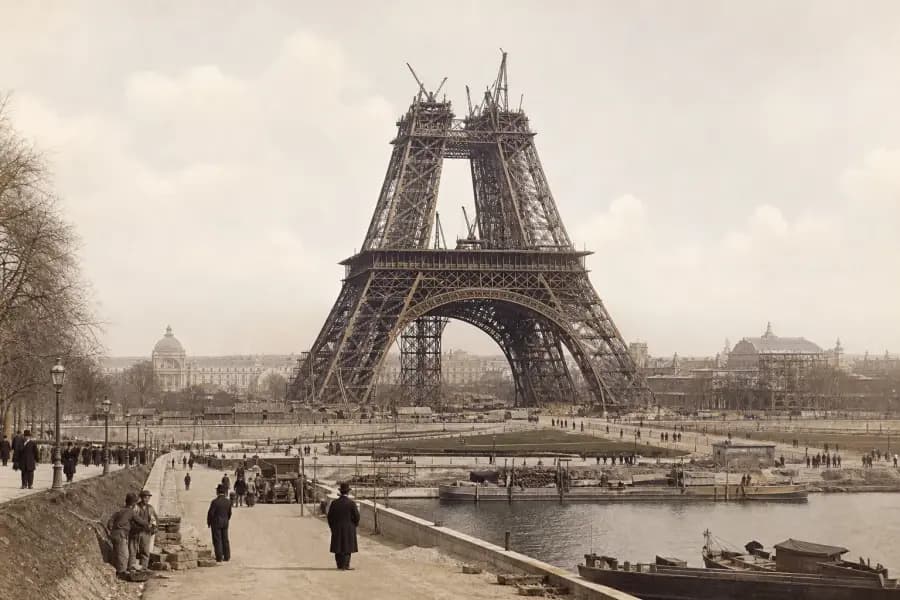
Estimate a range before choosing a year. Find the newest technology that must already exist, the oldest feature that has not yet been replaced, and any event-specific clue. Choose the midpoint only after checking that all three types of evidence agree.
What to know
- Think in ranges first: ancient, medieval, early modern, industrial, 20th century, or contemporary.
- Technology establishes useful earliest-possible dates, while missing technology can provide a cautious latest-possible date.
- Specific construction stages and documented events are more precise than general clothing or atmosphere.
Build a date range before selecting one year
A timeline slider demands a single answer, but historical reasoning begins with an interval. Start with the broadest era you can defend. Then move the lower boundary forward when you find a technology or building that could not yet have existed, and move the upper boundary backward when a later feature is conspicuously absent.
Suppose a scene includes electric tram wires, early automobiles, and dense masonry blocks but no modern high-rises. That combination suggests a broad late-19th- or early-20th-century range. Vehicle design, street lighting, clothing, and a known construction project may narrow it further.
Rank clues by how precisely they date the scene
Not every clue deserves equal weight. A famous event on a known day is highly precise. A building under construction may narrow the answer to a few years. A transport technology creates a wider boundary. General costume silhouettes or a sepia-like mood should usually remain supporting evidence.
- Most precise: named events, openings, disasters, speeches, battles, or documented construction stages.
- Strong: distinctive vehicle generations, infrastructure systems, and technologies with known adoption periods.
- Moderate: building materials, urban planning, industrial equipment, uniforms, and mass-produced goods.
- Weak alone: color palette, weather, generic clothing, artistic style, or an image's apparent age.
Use earliest-possible and latest-possible clues
Historians sometimes use evidence to establish a terminus post quem—an earliest possible date—and a terminus ante quem—a latest possible date. You can use the same logic informally. If a completed iron bridge opened in 1779, a scene showing it cannot represent 1750. If the same setting lacks later rail infrastructure that dominates by the 1850s, the absence may suggest an earlier scene, though absence is always less certain.
This method prevents one flashy clue from taking over. Write a mental bracket such as 1885–1910, then choose the year that best fits the full scene.
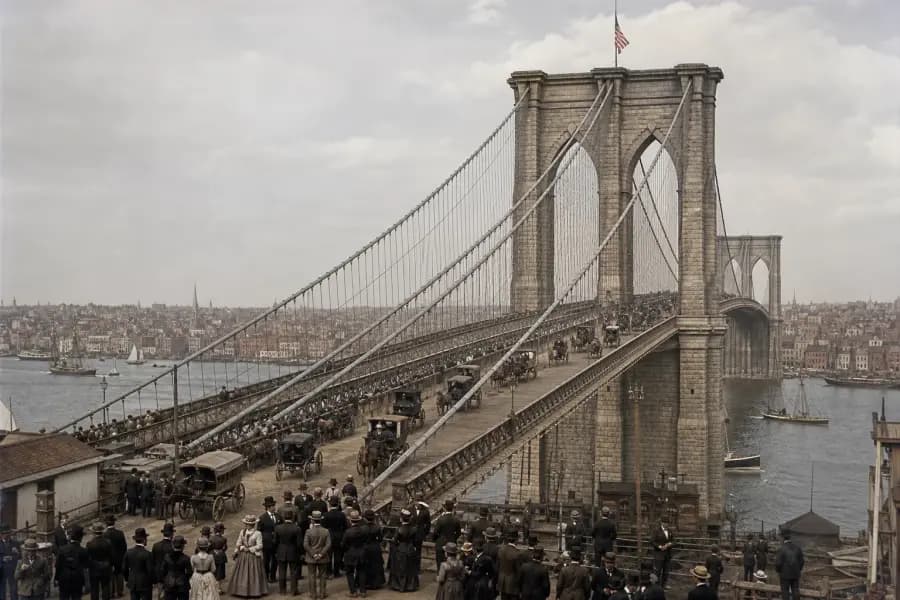
Why ancient dates require wider confidence ranges
Ancient visual reconstructions often combine archaeological interpretation with artistic choices. Clothing, paint, vegetation, and crowd scenes may be much less precisely dated than a modern vehicle or photographed event. Work in centuries rather than decades unless the scene depicts a specific construction phase or event.
EraGuessr's scoring allows broader time tolerance for older scenes. That reflects the nature of the task: being 100 years away in deep antiquity is not the same reasoning failure as being 100 years away from a 20th-century event.
A simple practice routine
After every reveal, record the clue that would have changed your estimate most. Do not write the answer alone. A note such as “reinforced concrete plus electric tram wires means after the 1890s” transfers to future scenes; memorizing one city's date does not.
Use the archive and era pages to compare several scenes from neighboring periods. Contrast is often more useful than isolated study because it reveals which technologies and urban forms actually changed.
Frequently asked questions
Is there a year zero in the EraGuessr timeline?
No. The interface moves directly between 1 BC and AD 1, following familiar historical notation.
What if I only know the century?
Choose a representative year near the middle of your best-supported range. Partial-credit scoring rewards a close estimate even when the exact event date is unknown.
Are clothing clues reliable for dating images?
They can support a range, but clothing varies by region, class, occupation, and artistic interpretation. Technology or a documented construction stage is usually stronger.
Put the clue method into practice
Play five scenes, then use the reveal to compare your strongest location clue with your strongest time clue.